Casting:
The ONE3 reels cast well and the Arrowhead casting system helps lay line
smoothly while providing additional space in which line can flow out with
reduced friction during the cast. Both reels make use of aluminum deep spools
and I found the casting distance on both reels to be almost the same, and even
with the Origin-C’s higher end bearings it just narrowly edged out the Origin-A
in max distance, but I did find it to be the better caster for making pinpoint
accurate casts with lighter lures.
Casting:
The ONE3 reels cast well and the Arrowhead casting system helps lay line
smoothly while providing additional space in which line can flow out with
reduced friction during the cast. Both reels make use of aluminum deep spools
and I found the casting distance on both reels to be almost the same, and even
with the Origin-C’s higher end bearings it just narrowly edged out the Origin-A
in max distance, but I did find it to be the better caster for making pinpoint
accurate casts with lighter lures.
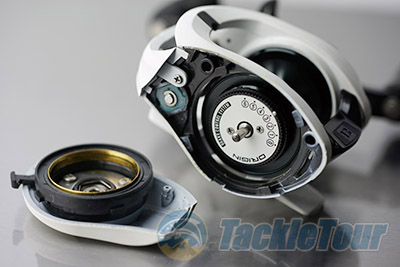
To access the 6 Way centrifugal
braking system the non-handle sideplate needs to be removed
Retrieve: Crank on the Origin reels and they both feel pretty smooth
thanks to Japanese Hamai Cut Aluminum alloy gearing. Over the course of the
tests the gearing held up surprisingly well and while these are not the
smoothest reels they are certainly better than I expected price considering. The
Origin-C was unquestionably the smoother reel and benefited from being equipped
with better bearings.

Unlike 13 Fishing's higher end
reels there is no Beetle Wing take down sideplate so be careful when adjusting
brakes on the water
During the field tests I was lucky enough to get into some really good fishing
days where I caught numerous 4 plus pound fish back to back with these two
reels. It was during this constant action where the difference between them
really started to become evident.

The Origin-A provides a smooth
retrieve
When there were small fish on the line or fishing
plastics I had a harder time experiencing any notable retrieve differences
between the reels, but when fishing larger reaction baits or reeling in any fish
larger than 3lbs. the power difference really started to manifest.

The Origin-C delivers both smooth
and more effortless retrieve under load
The Origin-C’s aluminum frame does a far better job isolating the gears to
translate winding power and eliminate flex under load. While the Origin-A’s
composite frame gets the retrieve job done the Origin-C’s more rigid aluminum
frame gets the job done with confidence.

When it comes to fighting big fish
the Origin-C delivers more confident winding power
Drag: With a sub 100 dollar price point you probably would expect a drag
that tops out around 10-11lbs. of pressure but 13 Fishing has equipped both the
Origin-A and Origin-C reels with surprisingly decent multi-disk drag systems.

A look inside the reel reveals the
aluminum gearing
The drag
systems on both reels feature multi-disc drags comprising of both metal and
carbon washers. In the lab the Origin-A topped out at 14.8lbs. of drag and the
Origin-C delivered 17.3lbs. of drag which is very close to the manufacturer’s
published ratings.

The Origin-C makes use of higher
grade high-spin bearings
In the field both of the drag systems proved to be equally smooth, but the
Origin-C offered a noticeably wider range of adjustment. Both drag systems are
adjusted via a swept star is made out of plastic. While they are the same shape
the one paired with the Origin-C felt higher-end with the gloss coating whereas
the Origin-A makes use of a raw plastic star and spool tension knob. While these
differences are subtle they start to add up and the more I fished with the two
reels the more the Origin-C started to separate itself when it came to both
refinement and performance.

The Origin-C has a beefier drag
consisting of both steel and carbon fiber washers sandwiching the main gearing
Ergonomics: Both Origin reels offer a very compact form factor that sits
low enough on just about any reel seat to look and feel just right. The short
and flat nose on these baitcasters make the reels very comfortable to palm. The
Origin-A weighs in at 7.2oz. and because the Origin-C makes use of aluminum it
is .2oz. heavier, but in hand that additional weight is almost indiscernible.

The main gear is Japanese Hamai
cut. Hamai has a well earned reputation for high precision gear hobbing and
polishing
I not only prefer the look of the Origin-C reel’s matte finish but also how it
felt when palmed as well. It was easier to maintain a comfortable grip on the
Origin-C but on the downside I did notice that over time it was also the reel
that seemed to pick up more dirt and grime. The same can be said about the white
knobs on the Origin-A. Luckily in both cases all it took was a little soap and
water to restore these surfaces back to looking nice and clean.

The Origin Reels have a short
squared off face that is very comfortable to palm
I found the barrel knobs on both reels a to offer plenty of grip, even when wet.
The only ergonomic downside to both reels is that adjusting the 6-way
centrifugal braking system requires opening the non-handle sideplate, and unlike
other 13 Fishing reels the ONE3 does not have a beetle-wing sideplate and
separates completely from the frame. Better maintain a good grip on that plate
if your making adjustments in the field.

The spools are similar but the
Origin-C (right) is anodized gloss and has extra grooves where the spool comes
in contact with the line
One nice ergonomic addition is the integrated hook keeper into the top of the
reel. This makes it easy to hook Texas Rigs and even Crankbaits onto the reel
for quicker access and deployment. Here the matte finish on the Origin-C once
again had the advantage as the finish did not scratch as easy as the shiny black
paint on the Origin-A.

One feature you wont find on
competing reels is the KEEPR integrated hook holder
The addition of the KEEPR integrated hook holder is an added feature that you
simply don’t find on other reels. You could argue that you can just hook any
lure on any baitcaster in the same way but the KEEPR design helps isolate hooks
and prevents lures from moving and scratching your reel unnecessarily.

The Origin-A makes use of more raw
plastic components
Next Section: Which ONE would you pick?