How G.Loomis Rods
are Made – A Behind the Scenes Look at the Factory’s Secret Sauce
(continued)

 Once
this drying cycle is complete a quality control technician brings each and every
rod to the inspection station where the rods undergoes additional testing to
ensure that not only are they cosmetically correct but they exhibit the right
intended action. Once the rods are cleared by QC they are finally put into
inventory. G.Loomis Inventory is now kept both here in Washington and in
Southern California at the Shimano distribution facility.
Once
this drying cycle is complete a quality control technician brings each and every
rod to the inspection station where the rods undergoes additional testing to
ensure that not only are they cosmetically correct but they exhibit the right
intended action. Once the rods are cleared by QC they are finally put into
inventory. G.Loomis Inventory is now kept both here in Washington and in
Southern California at the Shimano distribution facility.
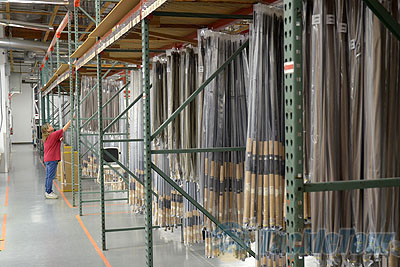
Once the rods
pass Q/C they are placed into inventory
The G.Loomis factory is
also home to the company’s R&D center. Here a team of engineers work with
designers including Steve Rajeff and Product Managers like Justin Poe to come up
with new rods designs and processes to continually step up quality. Here we saw
machinery designed to test and measure rods as well as prototype machines, that
were not yet in use, that are designed revolutionize the company’s painting and
finishing process.

Inventory is
kept of all rod tubes and socks in this facility as well
Also housed in the
facility is the warranty support team which comprises of the very service
representatives that anglers talk to when they have a rod that needs to be
replaced. G.Loomis’s popular Xpeditor program allows anglers to replace a broken
rod expediently and without question. For a 100 dollar charge rods are replaced
in advance and once anglers receive the rod they just need to put their broken
rod into the same tube and affix the enclosed pre-paid shipping label on the
outside of the tube. This team processes all these requests and inspects all
incoming broken rods. To ensure the highest level of quality these rods are not
repaired and are instead destroyed.

At the back of
the production floor is the warranty replacement rod check area
Bruce showed me one final
section of the factory floor, an area he called his “favorite.” It was a wall
filled with pictures of customers proudly holding up fish and their Loomis rods.
These are pictures that customers have sent into Loomis on their own over the
years, and consist of snapshots with fish they have caught or good times they
have had while armed with a Loomis rod. I scanned the wall and pointed at one
particular picture which looked like a pile of rods which were absolutely
destroyed. Handwritten on the picture was a short statement “my dog likes Loomis
too.” It turns out that this was a picture of G.Loomis rods that a customer had
sent in after his dog got a little anxious from being locked up in the house and
decided to make this rod collection into some very expensive chew toys. While
the G.Loomis warranty doesn't cover anomalies like "dog destruction" Bruce told
me another story of a fly fisherman who was surprised by a swimming rattlesnake
while wading down in Texas and used his prized 9' #5 IMX rod to beat off the
approaching snake. Fishing sure can be exciting, and Gary Loomis thought that
story was interesting and ultimately decided to replace the angler’s fly rod.

Bruce's
favorite part of the factory is a wall covered with pictures of customers that
have enjoyed fishing with the company's products
Conclusion:
As we neared the end of the tour I glanced up and took a picture of a large
banner that was hung on top of the shop floor, it read “It is the goal of
G.Loomis to deliver defect-free products and services to our customers on time,
every time.” There is no doubt that the employees at the factory take pride in
their work and I personally noticed how many smiles there were on faces of the
employees on the production floor, especially when we took the time to examine
exactly what they were working on at their individual stations.

A large banner
hangs over the factory floor
It speaks volumes for the
G.Loomis brand and Shimano that these rods are true to their tradition and each
and every G.Loomis rod is built in Woodland, right where the company started.
These rods are not the product of an automated process where graphite prepreg
goes in one end and a rod is spit out on the other, if anything I was surprised
just how manual a process building each and every rod was. G.Loomis has a
reputation for premium offerings, and while their rods certainly are not the
most affordable, they are among the best when it comes to quality. Anglers that
fish G.Loomis rods are typically very passionate about the sport and it was
refreshing to see that the people at G.Loomis that construct these rods are
equally as passionate about building these tools. These rods truly are
“handmade” and the craftsmanship that goes into building a rod is just as much
an art as it is a science. While Shimano/G.Loomis has invested a great deal in
machinery to improve the quality and refinement of their production the DNA in
each of these rods is still the sweat equity of the company’s skilled employees…
and that’s the real secret sauce.
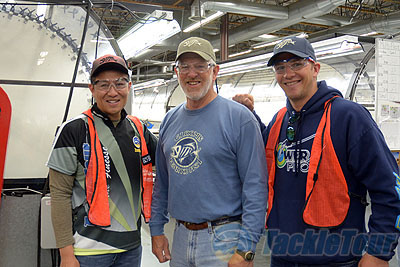
Thanks to
Bruce for giving us a behind the scenes look at the G.Loomis factory. These rods
are handmade right here in the U.S. and the secret sauce isn't just the rod's
design and materials but the experienced employees that construct these rods
each and everyday
With the tour done it was time to fish some of these rods, and I spent the next
two days fishing with Bruce Holt and Pro Angler Renauld Pelletier. Stay tuned
for part two as we hit the Columbia and Willamette River in search of Smallmouth
Bass.